
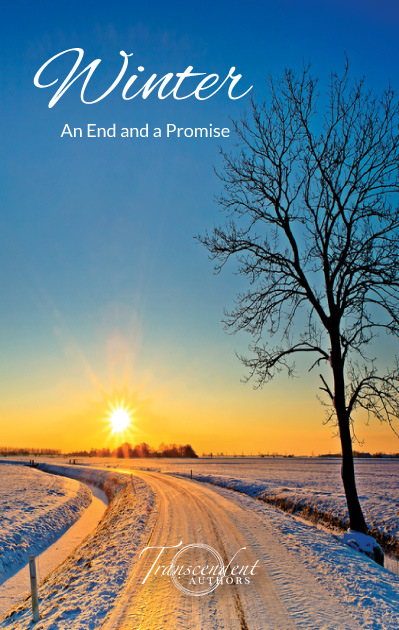
- Is winter an end or a promise of something new?
Ten authors come together to write stories of all genres. HERE you can enjoy listening to me read a sample from my story – Traditions Both stories are in the book and below:
WINTER is on sale Click HERE
Remember – we love reviews on Amazon, Goodreads and Facebook!
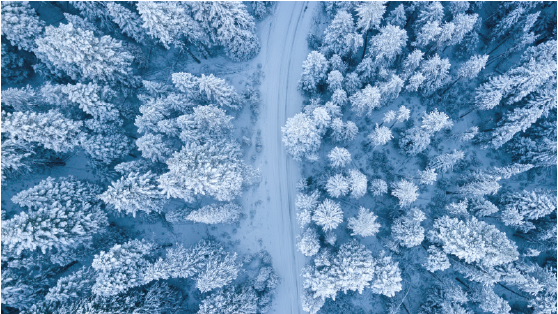
Chasing the northern Lights
Traditions -
A Romantic Horror
By Dena Linn
It is freezing or, being more accurate, many degrees below. I am beyond tired. It has been a long day, with trains and two flights, and now it is midnight. The Norsk Line airport bus glides, then crunches, to a stop in downtown Tromsø. The hydraulics hiss as the bus kneels. As soon as I step off, my lungs feel the dry air, and like nausea-inducing post-trauma, my brain snaps back. My mother is telling me – or being more accurate, writing on a pad by her bed – Go Andi, like you do! I am dry, itchy, sucking my last breath. She’d died the next day or the day after. And now she invades my dreams, night and day floating beside me on the wind, a woman I’d never really known. I feel the arctic air pull at my lungs and mother is in my mind’s eye, her wild, tangled hair flying around a tie-dye swathed body.
I shake my head, stamp my feet. She is gone. I’m here in this frozen artic town to support my girlfriend.
I have no sense of snow, unlike the Inuits and others who grow up surrounded by this white stuff. My mother was a surfer and a tried hippie; I knew only the sand and sea that had been outside our commune’s door. Now, the snow underfoot reminds me of sno-cones she’d buy me on the pier. I can hear the crystals crunch as I shuffle my boots, feeling for purchase. The tides surge and I head toward the blue-black waterfront, then trudge through half-meter-deep drifts to find the hotel entrance. The green arrow on my iPhone map indicates the scenic path along the docks. I hug the buildings for safety’s sake. Better to be in windblown snowdrifts than over the edge and floundering in a frozen harbor. I feel the weight of my duty-free wine bottle, padded with long underwear and an extra pair of pants. The load presses, and I hunch against the wind.
When I reach the hotel, I find the floor and a door and wave my key card back and forth. My skin tingles as it defrosts in the hotel hallway’s ambient temperature. Nothing happens, and I’m confused. I wave the key card again. Room 322! Jeez! Wrong room! Is my mind stuck on frozen? I wander on, searching for room 332. When I wave the keycard next, a door buzzes open. In seventeen square meters, my London friend, Polly, can’t hide. She jumps up, arms wide, eyes wider, fingers wrapping the stem of a half-filled wine glass. She envelopes me with sloppy kisses on both cheeks, Spanish style.
“You made it, girlfriend! Thank god! I’m a wreck.”
Polly pours; I struggle out of my boots and thick wool socks. It feels exquisite to strip off the layers. My skin breathes. I’ve never had so many things on my body at one time. I grew up half naked on a beach, covered in baby oil and iodine. Now, decades later, my body and mind are retired and cozy in the warmth of southern Spain. This trip was Polly’s idea, of course; she’s always had crazy travel ideas.
We should have a reunion and make it a Norwegian adventure. We’ll do it off-season in the dark of January and reconnect as amigas!” She’d texted with so many emojis I could hear her shouting ‘friends’ and the fun it would be to experience the aurora borealis together. Now, Polly sits back in the hotel chair covered by an oversize t-shirt and not much else, looking liquid. I am anxious to catch up face to face.
“It is going to happen. I feel it.” Polly’s voice is teary. She refills her glass, tops mine, and clears her expression. “First, before my drama, we must toast to longtime friendships and our quest to experience the aurora in all its glory!”
We take slurps of the wine, and the alcohol shoots into my brain. I stifle a giggle. Still, my brows and cheeks hike in a laugh. Polly’s eyes look grey and tired, and her bottom eyelids dam welling wears. Just weeks before, she’d shared via text that her mum’s health had taken a turn. Mum had already picked a quaint hospice located far into the countryside that would respect her specific beliefs and dying wishes. Polly’s mum had been a professor of indigenous cultures, and so Polly had grown up traveling with her, visiting mind-opening communities and different cultures from Northern Canada to Australia. A highway car crash, and then a heart attack, had taken Polly’s father when she was twelve. After that, Polly and her mum melded even more. The way Polly remembers it, she was an avid reader, and under her mum’s tutelage, learned her mum’s belief that all relationships were symbiotic, from trees and fungi to parents and children.
If I think back to my childhood, I almost can’t bring a clear memory into my mind, but I know I grew up with the smell of reefer and mother demonstrating irresponsibility as her form of love. In the face of bullies, I wore my Brownie uniform on a non-meeting day. I’d no other clean clothes, and mom reminded being bullied would make me mentally stronger.
In Polly’s stories of her and her mum’s shared beliefs, I found the reason why my mother visited me often in her death. She’d never figured out mother-daughter relationships or how to pass through her spiritual journey and rest. Before Polly and I confirmed our trip, Polly’s mum had moved to a unique hospice, and she fully controlled her morphine drip.
I scoot to the edge of the hotel’s chair, bring my elbows to my knees, my wine glass in front of my face. “Polly, your mum! And I haven’t seen you so long, so much girl chat to catch up on.”
Polly quips, “I haven’t added to my list of men. Left that tally sheet back in Spain with our sherry-drinking nights. I’m hanging with the current bloke.”
She throws me that knowing look. And before I can come back with something, the live-action movie of our history as friends plays double speed in my mind. I see all our times together, the mature friendship that grew between two single, independent women living the life of flamenco and fun in southern Spain.
I’d lost my mother to a gruesome cancer when I was just thirty-five. It was a shock, even though we were never that close. Then I retired, and with my mother dead, I found myself on a rooftop in a small Andalucian town, watching pairs of storks swoop and caw while Polly and I shared stories with each other like teenage girls. She told me she was running away from ‘dreary London men’ but terribly missed her mum. I’d told her the story of my mom, how we’d been more sisters than anything, and now in her death, she haunted me, trying to be the mother she never was. I couldn’t help, in envy, reminding Polly: You know how lucky you are to have a mother who cares about her daughter. After five years of rooftop tapas and sherry –Spanish feria seasons complete with appropriate flamenco skirts, hoop earrings, and flowers in our hair, and numerous of cultural interchanges –Polly went back to London as her mum started to show signs of slowing. Who wouldn’t have done the same?
That was six years ago. Life marched on. Polly was DIYing in her London flat, struggling with a new beau, and caring for her mum. I stayed in Spain, maintaining some of our mutual friends, learning Sevillanas, and whiling away my retirement teaching Spaniards business English. Polly and I had been kicking around the idea of an arctic adventure for two years but threw the plan together in earnest after her mum decided to move to the hospice.
Here we sit. To be more accurate, we slouch along with our wrinkles. Life has rolled forward, and my dear friend looks so distraught. I reach to clink her wine glass, to get her attention. “Hey, what’s on your mind? We’re in the same room now. We’ve got a good wine. All we need is a sexy Spaniard to flamenco for us and . . . tell me amiga.”
Polly shifts her rump, and her t-shirt catches around her knees. She takes a deep breath. “This is it. The end. Mum’s dying.”
“But, Polly, why did we travel? Gosh, we could’ve met anytime, anywhere. London even!”
“Ah Andi. You told me, appreciate mum while I can. So, since I left Spain, we’ve been living it up, mother and daughter closer than ever before. She stopped travel two years ago but, at eighty-six years young, she still had energy for her stream of international guests. Then, like a bloom through a cold snap, she faded, within days weaker, slow, begging off invitations. I had to prod. She hated to admit cancer had caught her, just as it had her sister and my grandmum. But in her last act, she tells me that I gotta go have fun and explore and live. Mum wants these last days on her own, and alone.” Polly sniffs but looks calm and pensive.
“You are the bestest daughter ever, Polly!”
“Oh Andi, you were a good daughter too. Our mums are different women, different mothers.” Polly takes a last sip and sets the glass resolutely on the table between us. “Mum told me, in no uncertain terms, that the hospice would text if anything. . .” Polly lets her voice fade.
“Life is what we have; grab it right now. That is what we are going to do.” I extract and unwind my long underwear from a bottle of good Spanish red. “We are on an adventure, and I hear you, Polly. Your mom wants you to have fun.” I rummage and find two airplane almond snack packs and open them onto the table. In one corner of my mind, there is my mother smiling, watching, approving.
Polly clasps her hands in her lap and sinks deeper into the hotel chair. “Thank you, Andi. Look, another red! You’re the ultimate girl scout!”
“Not sure how prepared I am for this kind of snow. Last snow I was in was the Southern Californian variety, Big Bear, and Girl Scout Camp! Ah, memories. Anyway, we will toast your mum and that we are together, amigas on a mission.”
Polly laughs. “¡Por supuesto! Friends on a mission!”
“Here – friendship, adventure” My voice is rising in the spirit. “To your mum and mine, wherever she is! And a three-night respite.”
Polly leans over to her bag and produces another bottle of red. “Yes, to our mums!”
The next day I am relieved that I don’t wake in my traveling clothes. We both sleep solidly, no alarm clock, but when I see the hotel LED clock glow 10:26 a.m., I pad, perturbed, to the hotel window and slide behind the drapes. Overcome with the oddest sensation, I press my nose to the glass. Outside is the black of night. I glance back toward the clock and then out again, searching for daylight. I inhale with care, let the drapes fall, and exhale.
“Polly, wake up. It’s wild, a pitch-black polar night like you read about. Like midnight and the clock says 10:30 a.m. Get up!”
Despite the lack of sunlight, we feel amazingly awake, and excitement vibrates between us. We are in a new environment. We load up on the free breakfast, something Norwegian hotels are famous for and flaunt without mercy. We scarf down fruit, muesli, eggs, and lox, then walk out into an indescribable royal-blue darkness. I wonder if everyone on the street might have also gotten up at the wrong time. I keep thinking it looks unnatural; surely, the sun will peak over the horizon in a minute or ten, but that day, January 4th, it never arrives.
We have a jam-packed trip, or being more accurate, there are just too many things to do in this city. However, when one is north of the artic circle, it is imperative to experience the northern lights. I could use a spiritual experience, but this is for Polly. Looking at an old sea-green lava lamp is just not the same thing, or so we have been told. First stop is Tromsø’s tourism office in the city’s brand-new ocean terminal building. All the tour assistants are super sleek like former ski champions: young and jumping, eager take you out on a tour. We angle toward a young, flaxen-headed man with a mile-wide smile, and a placard photo of the green and crimson lights we hoped to see. On the counter before him are brochures for their Light Chaser tours.
We both lean forward and point. “We’d like to sign up for that.”
His smile takes up his whole face. It seems fixed in place. He tosses his head so slightly as he laments with a voice full of syrup. “I am so sorry, ladies.” His fingers poke and stroke along his iPad, and then he spins it around. We stare at the grey screen with a roving green halo.
I have no idea what we are looking at, but we hunch over his counter. He backs up and announces, “There will be no Northern Light Chaser tours this evening. See?” He pokes at the screen. “Sorry ladies, thick soupy cover, the whole region, zero visibility. Looks bad tomorrow too. It usually blows away at some point, but no way to know when.”
In a surprising unison, we cry, “No northern lights?”
I exclaim, “Where do they go?” I feel like a small child. I want to jump up and down and demand a showing. “It is important. We’ve traveled a long way.”
The young man licks his dry lips, unable to close them over that plastic smile. In a low voice, almost conspiratorial, he says, “We’d love to call upon them specially for you ladies, but it doesn’t work that way.” He takes a step back, all businesslike firmness. “But you’ll love the dogs at Lisbeth’s HuskyTours.”
He has spotted the tour reservation email I clutch. We tug our wool beanies low and wave a lukewarm thanks. Polly’s phone vibrates and she checks her messages. The phone is back in her pocket, but Polly’s face is emotionless, just determined. “Mum’s resting peacefully.”
While we wait for the city bus to take us to the HuskyTours, Polly’s face takes on a somber shade, more like the sky. I reach out a gloved hand and squeeze her shoulder. Under our feet, the cement is wet, though snow-free. “Hey, they must have heating under the sidewalks here. Wild.” I try to laugh, to lighten the mood. I am bummed about missing the lights, but I imagine Polly’s mind is not thinking of that.
Polly suddenly stomps her booted foot. “We’re seeing these damn lights. We have to!”
I give Polly a little hug. What’s there to say? She’s come here so we could spend time together. Yes, also to come up for air after years of caregiving. She needs this break and deserves it. Her mum has moved to hospice. Maybe these are her last days, and Polly wants this trip to count, to mean something. For Polly seeing the northern lights might do that, help her put into place her mum’s life and beliefs. On the other hand, it may not be that at all.
“It’ll be okay,” I say finally. “We’re on our way.”
Polly looks wan. When the bus pulls up, we pile in and jockey with locals for seats before she speaks again. “It is everything – you know, I sometimes want just to jump ship. It’s my bloody DIY life, the flat, trying to manage a boyfriend, and yeah, my mum. I can’t turn it off; she is in my mind, and I worry.”
The bus travels a bridge over the sound of Troms Island and passes the city’s Artic Cathedral, not made from ice, as I had naively imagined, but still spectacular. Then, the view of downtown Tromsø disappears and we arrive. Deep snow surrounds the huge carved sign flanked by wooden husky statues. The bus driver honks and calls, “Have fun. Say hi to Lisbeth!”
Lisbeth comes out and greets us. We are a total of four pairs for the tour. It is easy to see from her physique that she is a champion, and not hard to imagine her winning both the Iditarod and the Finnmarksløpet. She stands strong, but her face is calm and relaxed. Before us is a dog-house complex extraordinaire. We count sixteen rows of four duplexes, set three meters apart, each housing two dogs who have nameplates over their entrance. Lisbeth explains, “All our dogs have their own space, sharing a duplex. Their neighbor is their partner, whom they must trust and cooperate with at an instinctual level. Communication between a pair of mushers is absolute key to maintaining a winning team.”
Lisbeth further explains her operation, standing with her dogs, a fantastic backdrop of birch and Scots pine, and the creepy black-and-navy-blue washed sky. “Here, in the Middle Boreal region, close to sea level, it’s perfect for raising and training sled dogs. These are my special breed, a cross using four different types of husky and malamute. The goal is body mass for strength and lean muscles for speed. We are a huge family and every member, old and young, is a key player. And our guests are too, because you give the dogs love and feed their sense of purpose – they are born to run.”
I whisper to Polly, “So sweet; what an operation she’s got!” I think of my mom and feel she is around approving of their individual homes. She loved the shared dogs of our commune who each had their own house. Mom would have appreciated Lisbeth’s setup.
We follow Lisbeth, and all the dogs wag furiously as we approach. Stunning creatures looking so intelligent, confident, and strong – eyes shining, ears swiveling. The champion says, “They all hope they’ll get picked to run, but we already have your teams harnessed up and ready beyond that fence. Time to get your coveralls on and get to sledding. I will explain more before you take off.”
“I hope they picked us the cutest and strongest. I am up for the long and winding road.” My sentence ends on a melodious note, remembering a Beatles song my mom would sing.
Lisbeth moves us toward the dressing room. “Remove your boots and get on a coverall suit that fits closest. Sledding boots, all sizes will be on your way out.”
Polly taps me. I see anxious eyes. “Update: the hospice says Mum’s peaceful but breathing shallow. I wish I could be there.”
I put my hand on Polly’s arm. “Yeah, I know. She’s a wonderful mom, and you’ve never left her side since you returned from Spain. She’s doing – alright. Remember you told me, this is her choice. From her body and with her spirit, right?”
Polly shrugs, and I continue. “When you and I first met over sangria, I shared that my mom was a hippie and you’d proudly told me your mum was an indigenous warrior, remember? And she still is!” I give Polly my most encouraging smile, but she turns toward the cubbies with snowsuits for safety. I hear her loud exhale.
Perhaps I was of no comfort, but Polly turns around bright-faced and refocused. The jumpsuits are giant blue insulated onesies, with an industrial zipper and plastic footies attached at the ankle. Large is good as they fit over all our layers, but they bunch seriously around our ankles and waist. We look like clowns, complete with oversized feet. Polly and I laugh as we pat each other’s padded rumps.
“Don’t forget to tie the hood tight under your chinny chin chin!” Polly laughs again and draws hers around her forehead and tight down the middle of her cheeks.
“We are a sexy pair!” I reply as we waddle and crunch our way out to meet our sled team.
One of Lisbeth’s helpers introduces us. “Your two lead dogs are lovely ladies: Daisy and Maisy. They are focused, confident and know their job. They’re trained – no room for mini-adventures! They are responsible for keeping the gangline tight; that’s this plastic-covered wire connected to your sled and each dog. Today we are running Daisy’s son, Docket, right behind her with his partner, Rocket.”
Next, he points to how each dog is connected to the gangline by the harness along their backs and also by their collars using a neck line. He pats Rocket and Docket alternately. “They’re your swing dogs – young, tons of energy, and learning all the way.”
Polly gives a weak smile and says, “Hey, learning? I’m not sure I want swing dogs who haven’t learned to swing!”
“They have been performing exceptionally. Their job is to help steer and keep the sled on the trail. These two beefy guys at the back are Bob and Rob. They do the heavy pulling. But you two girls” – he casts a critical eye over our blue onesies – “don’t weigh more than 125 kilos combined.” His smiles exude clever confidence.
He shows both of us how to stand on the footboards behind the sled and indicates the break-bar in between. He settles me into the sled’s covered bed, and I lean against my backpack for padding. He throws me two reindeer tarps that I tuck around. Polly will drive first, standing behind on the runners.
She says, “Yikes, it is scary seeing all this energy attached to our sled. Think I am going to be riding the break!”
We are the last team to head out, and I hear the assistant yelling, “Don’t ride the break. It upsets the dogs!”
My jobs are to hold on and take photos. I can see the muscles of Bob and Rob’s hind legs pulling to get us up to speed. I urge the dogs on, but know they are not listening to me. Polly laughs hysterically as the sled lurches forward and gains ground on the sled in front. I start laughing too as I’m bounced. It is thrilling to be zooming by these tall trees and snow-covered bushes, watching six tails swing back and forth, noses aiming like missiles. I know my iPhone is snapping mostly dog rumps and the blue-blackness of the forest. Twice, I hold my phone backward over my head, hoping to snap a photo of Polly steering. It’s exhilarating in this age of high tech to be feeling the crisp air and watching the snow slip from boughs of trees, all while being pulled in a sled at top speed by six fluffy dogs.
The other two sleds are still in front, but our team has lost ground. I try to yell back to Polly, thinking she is standing on the break. Ahead is a bush with a lot of movement, and just as quick, a group of beige snow hares pop out and scamper across our path. The dogs yip, and the two swing dogs swing off to the left, in the direction of the hares. Then the dogs, sled and all, are off the trail. I hear Polly scream, “Oh shit!”
It happens like a bolt. I am thrown to the side of the sled bed as the dogs take off from the trail, clearing a half-meter snowbank, and charging forward, dragging us into the forest.
I am swearing and grasping the sled’s sides. The dogs are spooked, crashing headfirst through bushes and skidding by tree trunks. Polly and I are yelling stop! The dogs are deaf in their manic leaping. My heart banks, but my brain has no space to contemplate dying in a dog-sled crash. I can see the dogs, bent heads, tails stiff like wire. Polly screams and everything moves in slow-motion as the sled shivers and slams. I see Daisy and Maisy, Rocket and Pocket leap, front legs extended. Rob and Bob and the sled slam smack into a hard snow-covered something. Dogs are yipping and shuffling, tangled beyond hope in their gangline. Then all becomes quiet. I’m on my side, padded by reindeer tarps. Stunned, my ears adjust to the forest sounds of birds rustling on snow-padded tree limbs. My lungs suck in frozen air. I hear the panting dogs, their low whimpers, and then Polly’s cursing cries. I wiggle sideways out of my cocoon, my backpack still secure, and spy Polly sitting three meters behind me.
I crawl over. “You OK? What a ride!”
“Yeah, wow.” Polly undoes her blue jumpsuit.
“Polly, keep the suit up. It’s cold.”
“My phone was vibrating.” She pulls it out and looks dumbly at the screen.
The electronic light casts its artificial glow over Polly’s face. It is eerie with the backdrop of thick soot-grey clouds and murky blue sky, just as the Light Chaser guide’s dispiriting words promised. The sky’s color is again settling over Polly’s face. She sighs long and coughs in the cold, then hands me her phone.
Your mother’s death was peaceful. Her soul has returned to Mother Earth, who nourished her body and now will reclaim her physical form.
“The hospice sent this? Oh, Polly.” I hug her tight for a long moment, then look into her eyes. “Come on, girlfriend. We need to move, check if anything is broken, make sure we don’t freeze. Can you get up?”
I help Polly to her feet. Though wobbly with tears cresting her eyes, she takes a step, then looks at me, shocked. “She’s dead then.”
“Come on Polly, let’s check the dogs and move a bit. That’s what we should do!”
Polly stands stiffly. I wriggle the reindeer tarps out from under the sled and lay them together next to the dogs, who are already huddling together in a furry pile. I pull Polly onto the tarps and then get my backpack off. I have a map, a guidebook, and breakfast granola bars. Ripping one open I say, “Take a bite.” Then I give each dog a bite as well, and they settle around us like a windbreak. Polly and I lay back exhausted. I stare past the trees, feeling at a loss for words. I manage, “Are you ok, Polly?” She is staring up, but I don’t know at what. I can only add, “I’m sure Lisbeth will find us soon. We are not that far off the trail.”
Polly whispers, “I feel like I should be burning sage or saying some special prayer. I feel so lost, and we are friggin’ lost!”
I touch Polly’s arm; we lay side by side on the tarps. “They’ll find us soon.”
I turn my head, stare at the clouds, and wonder if my mother will make an appearance. The dogs’ harnesses softly rattle. Their breathing slows, tails wrapped around noses. Then, on my face, an imperceptible change. I feel it, a breeze that’s petal soft. Polly and I are laying, listening to the dogs, and watching the dark wooly clouds drift along in one slow, drawn-out moment. And then, specks of light appear in the sky, a glow and flash like fireflies. In a silent flicker, a colored, phosphorescent tongue lashes out from behind the clouds, vivid and dazzling. In concert, the clouds and their cloud babies depart, drawing back to the corners of the sky. A honey-flowing river of green and blue undulates in an exotic dance across the heavens.
Polly’s arm lightly falls over mine, and she whispers, “That’s her! That is them! The lights!”
The sudden wash of delicate colors, too stark for pastel, but soft like baby’s breath, shimmer now. I’m blinking, thinking it’s a mirage. Polly is staring, dry-eyed. First the lights are long colored scarves, rhythmic gymnasts with no human form. Floating, contorting, then spinning free in a tease of something that flashes, these ribbons meld into each other, or into transparency. The wind is silent like the sky. A conductor off stage raises his magic wand, and the silence is awash in moonstone, sapphire, and aquamarine.
We turn towards each other, our faces squeezed by our hoods. Polly says, “You know, I feel mum. She’s there, just like she planned.”
I look up at the swirls and pulsing and feel my body weightless, relaxed, as if the air around us was rarefied and carrying me away. I breathe deeply and listen. I recognize her by her tie-dyed smock. My mother is up there too, arms and legs spread wide with her wild hair floating in those waves of psychedelic light, my hippie mom. I hope she sees me, her daughter, safe, smiling, doing fine.
In that moment, as another fantastic bounding of blue-green-crimson light shoots across the sky, Daisy and Maisy’s heads and ears prick up, their triangular listening devices start swiveling. Then Rocket and Pocket are up, their tails in a slow measured wag, as Rob and Bob jump to join and listen. Then, finally, the silence of the night is broken. Shouts ring out: “Maisy, Daisy, Andi, Polly!”
Between the trees, bathed by the aurora, comes a team of eight bounding dogs followed by Lisbeth and another team and sled. “We’ve found you, and what a light show you all have. Is anyone, any dog injured? We love these GPS collars all the dogs wear.”
Polly and I stand. We beam, then bend to hug Daisy and Maisy. Lisbeth and her helper untangle the dogs and our sled. Before we set off, we all, dogs included, take another moment to stare at the wonder that is the northern lights.
(© 2022 by Dena Linn. All rights reserved)
By Dena Linn
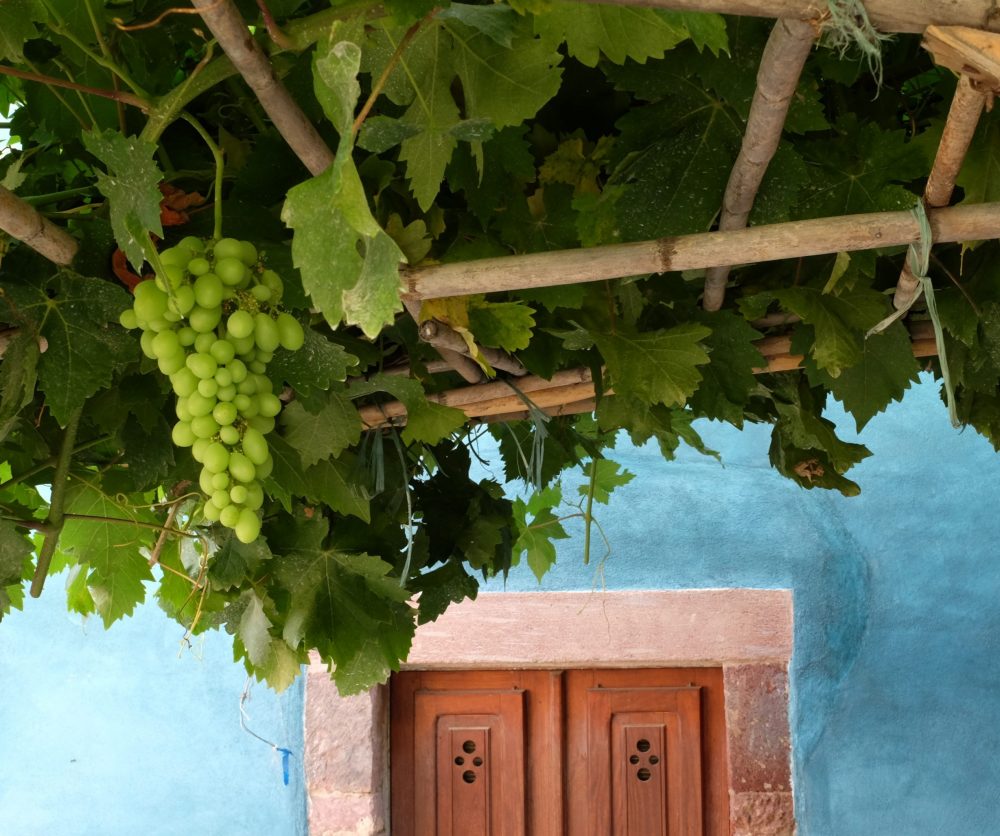
It was our love: the island, our soil, and the fruit the island gave us. We lived a peaceful existence, and kept our traditions, like our 500-year-old cemetery with headstones matching entries in the family book. Traditions are good; or so I thought.
My Papa, Lisandru, was out with his vines, a widower twelve lonely years. Mother had died of grief exactly twelve years after Greta, the big sister I never knew, passed. It was typhus that took her. Greta succumbed twelve years after my father’s brother, Uncle Galpin, had been slain in a horrible fight. That left Papa and me to care for the grapes, the land, and men who came, every year, to take our wine in barrels away to their homeland. I called them our ‘clients’. I was naive and fearless.
Papa said, “Soon you will understand, Gianna.”
I’d learned our people had lost many battles, retreating to hide in the mountains to fight another day. These men had first come to convert, then they chose to destroy and tried capture our very souls. In frustration, they chose to annihilate. and we fought, brave, fierce. Their soldiers perished on our land, and their boats came no more. The island, culture and language was ours and our soil even richer with their blood. We grew grapes and made wine we knew was the finest of fruit and earth, balanced and rich. Then, again, these men arrived on our shores, but their armies stayed back, menacing from the beach. This time, they came wielding wealth, a religion, superior knowledge, and a thirst for our wine.
Never far from Papa’s lips, his guidance escaped in a sigh. “My beautiful daughter, you’re growing up before my eyes, soon you will be 16 and the time has come for you to comprehend what the cost is for our island’s peace.” He cried silently, I imagined, for mother and Greta.
I could not understand Papa’s despondency; usually his face was carefree. He had me, and I was strong. Our grapes grew fat in the sun and our island was peaceful. Life was good, but Papa’s gloom wasn’t lifting. He sat, endless evenings fingering pages of a leather-bound tome: the island’s history in our family book. He’d told me it was full of secrets and traditions bequeathed to us and our island, its strength and protection.
“These pages recount our island’s glory and its fate.” He waived the book, challenging me to understand. I’d never dared, fearing it contained secrets I would regret knowing. When I opened it, dates of deaths and names swam up toward me. I turned away, but Papa’s fingertips were gentle against my cheek as he guided my gaze back.
“Read.” He spoke.
My middle finger felt the page-edges pass and catching Papa’s serious eye, I allowed my ring finger to catch a leaf. Opened, I read out loud down the list: 1771, BibiMaPose, drowned; 1783, BroPose, poisoned; 1795, LittleBro, disappeared. I flipped a few pages back.
1363, TioGastag, sweating sickness. Traversing forward again I found names I had heard in stories: 1831, Great, great grand Uncle Antonix, scalpel to his own neck, and then 1843, Aunt Chiara, kicked by a horse. There were more: uncles, aunts, cousins, dates of death and causes.
I turn to the latest entry. 1891, Sofia—my mother’s name—grief. The line directly above, 1878, Greta—the sister I never knew—typhus. Young and old, unlikely mishaps, sickness or mysteries, someone in our family had died every 12 years!
My 16th birthday had just passed, but my eyes reflected nothing but incomprehension.
“You call them clients, Gianna, but they are devils.” Lisandru sat heavy, our ancient language coming slow on his lips. “They fought us for generations, but we were smarter, they never found us hiding in our hills. Frustrated, I suppose, they sailed away, and we had our soil and peace. But that did not last for long.”
“And the book, Papa. And those who come by boat to buy our wine and fest with us, are they devils?”
“My daughter, time is lost but traditions lives, and peace will always have a price. Our foreparents lived a life of war and strife, wanting only that we not share the same fate.”
“But Papa, we have everything! What do we need?” The pitch of my voice rose in supplication.
Papa slumped, then pulled himself straight in resolution. “Gianna, all the wine is theirs, and we have this.” His gaze followed his hand as he gestured around and out of the window. “One gets nothing in this world at zero cost; a life every twelfth year is a small sacrifice.”
The window was open inviting the aroma of the rolling hills striped with trellises and lush with the summer fruit; beyond, the beautiful blue-green sea lapped at our shores, its drifts the playground of seagulls. We lived in a paradise of dark soil, cool mists, and the best wine. We could speak our language, sing our folk songs, and be joyful, far from another land’s strife. Papa knew best; some sacrifice must be made. Then a worrisome thought sprang to my mind.
“In the family book, Papa, I saw 1903 written. That’s next year!”
“Yes, but if you lay with a man, we’ll have a child to pay the debt when these men arrive.”
“I don’t want a child, Papa.”
“And then they will take you, Gianna. Must I sacrifice another daughter for our island’s peace?”
Lisandru took a deep, sorrowful breath. “It will be alright. You’ll never know the bairn. It’s the sacrifice. That is how our we live life in peace and survive.”
I sat in my room, my dressing mirror catching somber reflections. What had started as indistinct bumps on my chest, had blossomed to a womanly figure. I could feel an energy run through my body and wipe away the fear that Papa had left in me. My shoulders arched back, and a tight-lipped smile bubbled to my lips.
Papa’s reasoning was too simplistic. I couldn’t imagine how our family had entered into such a fantastic business arrangement, and what cold-hearted person could kill a child? Yet, I understood Papa’s protective impulses. He feared for my safety if war came to our land and blood ran again in our streets. I’d matured and felt I could now pity him, laughing away the dreadful tradition and deciding against having a child for whatever purpose. The fear was gone as I ran my hands over my breasts feeling the power. I would not be bullied, as my Papa was, and our ancestors had been.
##
The sun was sinking lower over the ocean’s froth and harvest time came. Lisandru said, “You’re not pregnant. We will be ruined and Gianna, we will lose everything that we love. Think of your mother, her sacrifice.”
“I hardly remember her, but if she was a sacrifice, she left me, her only daughter!” I was indignant.
“Gianna, please! Find the calm in our regal vines, our peaceful lives and our shinning coast. I trust you to arrive at the correct decision.”
I was genuinely torn. The reality was complex; my woman’s body surged under my skin, and I thought often, like a festering splinter, of the woman, my mother, who’d left her child. Would I do the same or kill my child instead? I roamed our hills and valleys, caressing each grape vine, urging their leaves towards the sun and asking for any wisdom they could share.
There was a boy. His family helped us. They worked hard and would have been starving poor, like all who lived on this rock, if not for the vineyards and the peace. I could lay with him, although a simpleton and — so crude! Just the thought of sharing myself with that silliness turned my mouth sour. The months clicked by as the grapes and I soaked in the sun, maturing, sweetening.
1n 1903, I turned 17, and was old enough to accompany Papa at the grand wine tasting. Luxury yachts, gleaming white on a sea of blue, steamed close. Smaller landing boats filled the shallow waters, bringing them ashore.
Everything was festive, the island was pulsing. Lights and music, horses with flowers in their halters, and all the windows open from where our island flag was seen waving. I was dressed in traditional white with a blood, red apron. The embroidery at my hem told the ancient story of our island. “Oh Papa, our wine is surely the finest, spice-rich and island sun; mainland wines, thin and blush, can compete. Such nose, such color, it’s the work of a master winemaker and that is you! Everything will be splendid.”
Papa, looking smart in his formal black, leaned towards my ear, is forehead knit tight. “They’ll notice you’re not with child. I am just an old man. They will not be pleased.”
The tasting was to begin, our clients entered. Elegant suits stitched by private tailors, Borsalinos on every male, and arms cocked holding delicate divas gliding on kitten heels. The last woman walked tall, alone, goddess-like. Her emerald cape swept down from her shoulders and my gaze fell into the scoop of her neck, then floated upward to the soft indentation below her lower lip. My fingertips came alive as I regarded her lips, soft and pale against her skin, longing to touch. Her eyes blinked like a cat’s, in my direction, then darted away. I was tongue-tied, trying not to trip over my toes as I followed her smooth sweep of auburn hair and sculpted back. I overheard and was not surprised her name was Rose and I was drawn, a trust up from deep between my ribs, that I’d never experienced. She stood apart, regal, emanating, attracting. I felt caught.
My mind spun. I wanted to press my lips against her neck, then reach higher for a tiny bite. Who could possibly contemplate tasting glasses of wine when such a beautiful women stood amidst them? I finally caught her eye and was acknowledged. My reward was to escort her through our vineyards and accompany her during the tastings.
Dinner appeared, and I felt her knee hot, pressing against mine. We had smiled and spit wine together, and now, she took my hand and placed it on her thigh’s smoothness. I’d stopped breathing. It was not the wine I was feeling; it was the universe. After dessert, she taught me what it was to lay in love, and Papa’s visage flew far away. An unknown well within me over-flowed as our hands roamed wild, our arms wrapped each other like warm caramel, soothing and rocking in a corner of the wine cellar. But those cat eyes held dark currents as she voiced a susurrus of my name.
I felt drunk from her touch and said, “I love you, and much more than the wine surrounding us.”
The tasting was a success; Rose had turned her back but waved to me as her boat sailed from our shores. My father reviewed his bankrolls and congratulated the island’s wineries for all their work. Weeks fell away, and I sat at my window dreaming of Rose. Papa invited that boy from the village for aperitifs. It was awkward, especially when Papa begged.
“Gianna, we’ll lose everything. Just let him between your legs, a short minute, and we’ll be saved. The year is running out.”
However, in my mind, I lay each night with Rose, re-experiencing the joy and thinking nothing of Papa’s fears. I had discovered real love in our wine’s cellar.
Lisandru and I traveled the island, inspecting grapes, tasting for sweet and tart, but my mind saw Rose’s lips in every fruit. As a brilliant winemaker and father, he taught me with patience and care about every aspect of creating a memorable wine. Yet, I still couldn’t fathom how our family had become hostage to this other land and its evil. Why was our wine, surely the finest on earth, not enough for them? Why did we still have to pay for peace when they could have all our wine? That someone had to die every twelve years was absurd!
Every night, Papa and I sat with a good bottle. I thought of Rose, my love, so far away. “Why, why do we have this curse?” I asked him, over and over again.
He lifted his wine glass to his lips. His eyes were dark, his lids heavy with sadness and years. “It’s a part of our history, our blood, our tradition. We never question. It is who we are.”
Papa’s entreaties to have a child built to a frenzy, the topic was always present on his lips. I understood. We had only each other.
Then one day, he did not come back for afternoon coffee. When I found him, my world died even as the grapes glowed in the setting sun. He lay broken, legs crushed then chewed like dry branches under the wheels of his narrow-gauge tractor. It was a horrid sight, I gasped, vomit rose in my throat, and I cried out as his blood seeped into the brown soil. Papa’s life was spilling out, he still managed to say, “Gianna, I’m dying. It’s the twelfth year.”
##
The entire village came to his funeral. I was wrapped in the blackness of guilt, knowing it could’ve been me or my child. The carved gravestone spoke of a debt paid with Lisandru 1903, next to his wife, my mother and Greta, the sister I never knew. All the headstones matched that 500-year tradition detailed in Papa’s book. The service was over, and the dug earth smelled gentle and decadent as cut figs.
Sorrow and worry seeped into me. I sobbed. “Twelve more years.” Through my shroud and grief came a breeze, forming an image: Rose. Her high forehead and long neck, cape swirling as it teased her lower legs. Her fingers pinched a stem and letting the single rose blossom tilt following her chin, she turned glowing like an afternoon sunset. She’d come; she’d heard about Papa!
“I am so sorry for your loss, Gianna.” We were alone on the hill and the birds were silent. She stroked my cheeks, her palms drying my tears. “We will have our special love. Now is our time together.”
I stood on my tiptoes to nuzzle my lips to the lobe of her ear. In the distance, I spied soldiers: it was them. Wealthy, powerful; paying their respects to Papa—or were they waiting for something? Rose turned and raised her palm in a princess wave, then gazed into my eyes. I heard my heartbeat in my ears, weakened and intoxicated by her wide, black pupils that blocked her golden irises. She leaned in whispering into my hair. “We have to love each other — hard and fast. We must never waste a moment.”
“But why are they standing there?”
“They are waiting for the 12th year to come, my love.”
Rose’s fingers traced my ear, sliding down my neck till they rested at the narrow hollow between my breasts.
“But why? It’s an oppressive tradition, they took my father; just look at my family’s names in the cemetery. It is all so childish. My people were subjugated for over 500 years, but your people have all our wine and it is the finest.” I searched Rose’s eyes and I felt her arms hold me. “Our two cultures are together, look at us! In love we are one. Tell them!”
My love’s eyes turned dark; her forehead neatly creased. “You know it’s tradition. Your family’s curse lives on.”
A realization dawned as she buried her lips in my neck. I whispered, frantic, “We’ll have a baby in the eleventh year. One of us, the egg, one of us the womb. We can get pregnant, and it will be the sacrifice!” My breathing was hard. My hands raked her hair. Everything became possible when you loved.
“Yes, Gianna, but no. That child would be a part of me. They, my family, would never allow it to die.”
Rose stroked me to the rhythm of our heartbeats and chanted, “We shall dance in our love for eleven long years. Then I will prepare your death, as my culture mandates, and lay you next to your family, as is your tradition.
###
© 2022 by Dena Linn. All rights reserved