
A mother's love is forever

Summer: When Doors Open – BUY book. And enjoy my summer telling of a mother’s love below the Pacific Ocean sunset:
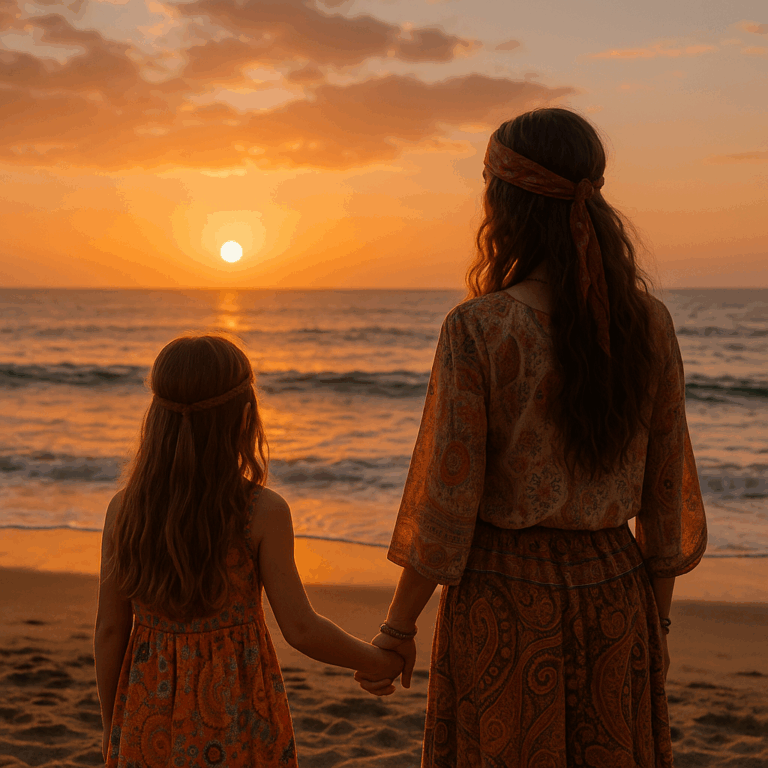
Watching, for now
By Dena Linn
It’s going on eight months. People talk of death—a state of passing, expiration, laying down, gone for good—well, I must be a conscientious objector. I object at any conscience level, (can you hear the sarcasm?); as I would if they drafted women. I will not simply lay down, not yet—I am watching my daughter, for now.
Setting my gaze on the ocean below, I see tiny sailboats bobbing and feel through my ethereal essence, the rolling waves feeding on each other for strength. It comes from violent tidal surges that spray up and crash, like the best sky-blowing high I’d ever had, and like the deepest drugged dives. I’d know those as well. Ah! Don’t go there now. Watch your daughter that she’s alright.
Nine feet off the sand, golden-bodied lifeguards strut and preen along the wide deck of their towers. They pause, hamstrings taut, chest muscles popping, binoculars scan. Families travel in sweaty cars and open station wagons from land-locked communities to play at this miracle’s very edge: the Pacific Ocean. Sand and waves are all too captivating—these visitors swim free and far, never noticing lifeguard flags, green, suddenly swapped out for red, the deadly ‘under-toad’ as you used to call it. I taught you to read those flags.
I see you, a slim child, those bluest eyes, tangled hair, a sunburnt wing across your nose and cheeks, that old striped bathing suit. You’re on the fried-egg hot asphalted boardwalk, prepping your soles. Shocking and burning the soles of your feet cause nice thick calluses to develop, so you can stroll, nonchalantly, over two hundred sizzling meters of sand to the dampened foreshore, like anyone who lives a beach life.
It is your beach. This has been your life since Claude, and the House took us in, a wasted mother and dirty child. Even though I can’t tuck you in, your sole prepping process begins, like clockwork, every June. Your bare feet, alternating heels, pushing through the balls and to all your toes. You grimace, pleasure, pain, pushing them into the steaming blacktop.
How humans tempt pain, convinced if they endure, it will set them free. Was I like that? Burnt soles, but do you feel something, anything, when you remember me? Or is the feeling empty? Oh, daughter of mine, a mommy’s wish is that you quiet your heart and trust. Look to the stars, I am there.
Now is the summer of your eighth year. You are fast maturing, as if going on twelve, swinging your arms as you move down the boardwalk toward home. Our commune house is a fine old dame with the requisite loose jowls. You laugh at the roof tiles that hang like fringed bangs, and the cement walkways, pacifists, we all are, live and let live, the cement cracks and is infiltrated by beach grass and ants, and soldiers onward.
But, damn, today that hurricane fence gate is open again, never a good sign. I imagine your brain ticking; I see you gaze down to the cracks and caught sand. No use running and calling through the house or into the back houses; Sport and Bandit are on the loose, and the wall phone is ringing. Lope up the cement stairs two at a time. The door is forever unlocked, and you have the beige plastic receiver to your ear before its ring wakes Jilly, sacked out on the couch.
It’s, as I know you’ve suspected, the dogcatcher. I see your eyebrows flatten with the threat, your lips repeating: two mongrels… put them down.
Your respiration responds, ribs rising, settling. “Yes sir, we’ll come get ‘em, sir! Thank you, sir.”
The receiver is sticky in your hand, and your gaze scans the edge of a Polaroid, stuck to the wall. You’re looking into your own laughing eyes, body full of movement next to Ed and Jamal, their heads thrown back, hips pressing tight. And there’s Jilly; the Instant film having caught and blurred her dancing arms. It is a new photo, so of course, I am not there; Claude must have snapped that.
Your eyes are wide blue and caught. Looking, your head tilts to the side. Tired, worried, thoughtful, or? Even as the particles of my body face constant bombardment by the air around me, I can sense your soul. You brush a palm over the photo’s surface, your spine straightens with responsibility, the dogs. My girl, mature… maturing.
You stare down at Jilly’s slack mouth, a crust of drool, one thin leg thrown over the couch’s back, one pale arm hanging to the sandy wood floor. She looks ashen. The black lights extinguished, pillows are strewn. What’s left is the lingering odor of a good party. You pivot, race up the stairs, door on the right, covered in those ubiquitous Ricky Ticky flowers and peel-and-sticks from Wacky Packages. Nimble fingers with bitten nails turn that combination lock, your private sanctum. Its focus: the Peter Max comforter purchased with gifted money from my asshole parents, (never gave me a dime!). You took the bus alone. I was so proud.
You dump your savings out and meticulously count the coins even as your eyes catch my smile in another photo held by a red pushpin. Your gaze softens as it reaches my Polaroid eyes. You love that photo, but I see it too and feel a mother’s shame. I’m super sexy, but not in that mother sense; in that hippie, stoned, free love sense, and for this, I’m sad. I hope you focus on mommy’s eyes and my beach body wrapped in your favorite blue and gold palazzo pants that I would wear. There are tears in the corner of your eyes. Can you understand, my daughter, even high as a kite I loved you more than the world and all its stars?
Yeah, our world is not peaceful. Women are not peaceful. This is a good thing. When I was there, I was steaming angry at the media, our class system, and the wars and poverty of its creation. We survived on the protests—they energized our commune and community. I was tripping with my angry voice, waving my sign, screaming my mind. I protested to make the world safer for you—you knew that even as the sky burned bright behind me. Polaroids captured a faithful image.
You turn away now, grab the change, and slam the door. Your combo lock is turned twice, like I taught you. Your eyes and cheeks are dry—my determined daughter.
“Let’s go Jilly—Jilly!” Your hand is on her shoulder. You shake her, shuffling back and forth on your bare feet. Your shoulders feel the heated wind as it blows through the open windows and out the back; the House breathes. Jilly wipes hair from her mouth, sticky sleep goop in her eyes. Her hands fuss then drop still. “Fuck, I’m sleeping.”
I’m confident you can get Sport and Bandit. You already think like no little kid. But I see you sometimes doubt, and you shake Jilly harder and whisper a closed-tooth hiss, “Come on. I need your help—gotta get the dogs!”
You straighten, something makes your heart skip. Maybe Claude’s ambled home or the threesome living in the old servants’ quarters are coming in the back door? Your head tilts, hoping, listening. The wind’s pushing into the House’s cracks.
You’re alone—you and Jilly. Her chest rises imperceptibly, she mumbles, “Damn f’ing straight!”
Hands on your eight-year-old hips, you assess. You pick up Jilly’s dragging hand and return it to the sofa. Out the door, you’ve slid into plastic zoories that you hate because they dig between your toes. This is no time to work on your calluses, but I know you’re thinking you can run faster if. . .
You kick off the slides, your lips twist, and you curse under your breath. I can’t tell who you are angrier at… me for not being there, the zoories, or the selfish, poverty-infested world you live in, and I have escaped. I wonder, but don’t worry; spirit friends advise against that emotion.
It takes you fifteen sweaty minutes, running up and down the boardwalk, past Hot Dog on a Stick, past the rings and bars, past the pier and back, to find the dogcatcher, a pudgy man, whose uniform belt is lost forever under an enormous gut. The pure muscle of his arms squeezes out from his short sleeves, meeting dark v-stains of sweat. That tiny cap with the city’s emblem is both intimidating and hysterical.
“Those two are mine, sir!”
“Where’s your parent?” The uniformed pudge demands.
“She’s not around.” Your voice is defiant, hands pressing your thighs.
“Law says, can’t release them to a minor. That’s the law.” He’s chewing a toothpick. It’s gross.
Sport and Bandit wiggle with joy behind the grated door of his van. They smelled you coming. You clench your fists, and turn from the man, from the dogs’ wet noses pushed into the grating. I see hot tears. I try to reach, to comfort your heart, but I can’t and don’t let myself go there. Life is a challenge; you can do it.
“Could ya stay here, please? I’ll be right back.” You turn and run.
“Bring a parent—kid!” He yells at your back.
At the house, Jilly is actually upright on the couch. Her white T-shirt is wrinkled and grimy gray, and the fringes of her jean shorts are sticking to the inside of her thighs. She is swaying on her pelvis, blinking. Jilly works in some store even though she can’t do simple math; this you know. But she is over eighteen and the only other person around.
“Jilly, we gotta get Sport and Bandit. Claude will come down on us royal-like for losing them. Come on!”
You drag Jilly by her wrists. She doesn’t appear much older than you and probably is missing her own mom. Jilly is, at least, upright and walking, sort of. When you arrive at the dog catcher van, her wrist in your grasp, you drop her arm and she stands free, twisting her hair, scrubbing an eyebrow, trying to play her part.
“Hey man, release our dogs.”
“You’re not her mother!”
“Prove she’s not,” you shoot back. Guess you learned from me about dealing with authority. I’m grinning.
Jilly loses her role and laughs, slapping her bare thigh. “Girl, that’s rich!”
“Gonna be two dollars, right here.” He holds out his palm, his other hand menaces, jangling the van keys.
My smart daughter, you have a clothesline rope ready, one end to tie around Sport and one end for Bandit’s neck. After slapping the change into his hand, you lead the dogs and Jilly back to the House. Jilly’s still laughing like she’s high, plops on the couch, squirms and twists, straightening the fringes. I can see your eyes, a shocking clear blue, from your father, but they are yours. I wonder if through those eyes—can I see your soul?
Dusk is settling, and you’re hollering into the yawning house. “Claude, you home? You awake? We’re back with the dogs!”
***
My mind plays memories, distant and fluid. We are on our beach. The wash of psychedelic foam rushes to cover our feet. Full of textures and smells, we stand, your little hand in mine, till the spilling breakers bring that shriek of laughter, your arms fling high, a child’s abandon, and for me, I am seriously tripping. Life is so sweet.
You look into my eyes and ask: Mommy, if I swim out, kick hard and never stop, will I come to Hawaii and hula girls with flowers, dancing on the beach?
We sit wide-legged on the golden sand; my high is mellowing, eyelids are heavy. I lie dead flat. The reds and golds behind my lids melt to a steamy rose and pastel. My head rocks, my hair halos in the sand. I’m making sand angels, legs and arms flapping, thinking they can fly. Next to you, your voice, as if it is yesterday.
Mommy, if I dig and dig right here, will I meet a Chinese girl digging towards me from her beach?
As we walk to the house, the sand dunes trip our feet. The smell of salt-rotted seaweed is overwhelmed by the orange odor of Bain de Soleil. The thwack of a volleyball, the grunt and blow, air rushing through gritted teeth as beach weights are hoisted high; the sounds invade our senses and souls. It is between fantasy and forever, being on the beach, being on the ocean-side of the boardwalk.
Years back, before you were born, my memory, like an obsession, found the emotion, texture and color of Jackie O. in her blood-splattered suit. Tragedy and horror do happen. Even so, we tried to trick ourselves into thinking those who rushed, with busy, worried looks, were somehow more honorable, worthy. They certainly were living the Walt Disney version of the American dream.
But I failed, crushing rebelliousness with focused teenage lust. He was older, suave and sophisticated. Everyone admired him, his position, money, status. My hormones, and that bewitching Disney dream blinded me. In his smartest suit, he took me by one arm, a showed me to his friends, like I was his luckiest catch. And I felt ethereal, his beautiful woman, even that my womb was stretching with child. Luck, just that snippet, found me; and he came with roses, his husky voice clear, as his hands explored me. “You’re young, your body is a glowing with child. Be good to me, and I will be so good to you.”
So, I ran from my dogmatic parents and disapproving school straight into his slightly used Lincoln Continental and the arms of your blue-eyed father. This was no simple teenage escape from parents’ claustrophobic confines. I’d stepped above my parents rung, and felt mature, beautiful. However, it was not long after your first steps, the Disney film ended and the projector just spun the reel around. Even with you, our perfect daughter, and your blue eyes, a mirror of his, your father came home later and then less. He’d tell me ‘business trips’, when he wasn’t raging or sulking. You were walking and started talking, the cusp of terrible twos, when I found out from some lady that your father wasn’t actually mine at all.
“Oh dear, poor you, and with that baby girl! And you, such a baby yourself. Oh, I’ve seen him with a redhead, laughing. Don’t-cha-know, men de’ all wolves!”
The only sounds I could force out were small and mewing. I swallowed choking, holding you tight. “But he’s married to me!” You wiggled and fussed, feeling my rocketing heartache. I jiggled you, pressing your babbling words into my shoulder.
The woman clicked her tongue, “Yes, honey, good luck wit’ that!”
The store’s florescent lighting bounced a murk green haze off everything. My stomach churned with acid shock, and you squeak, “I’m hun-gree.” Walking out from under that lighting, am awareness clicked inside me and I held you tighter. Your father was our food, our security and home; I mustn’t act different; I had to hold my dream together. I had to try, however, it was too late. His backhand slaps that he called mistakes were followed by roses. As makeup no longer covered the bruising, he brought nothing home except rage. I became frantic, and often was on my knees before him. Then, the ultimate blow, my Mr. Blue-eyed Continental walked out and never came back. Suddenly alone, I realized he’d never been there at all. We sat in that shitty one bedroom with little money and your third birthday approaching.
My old high school friends were either too stoned, too drafted, or too gone. And we were soon broke. I freaked imagining approaching my parents. I couldn’t listen to another: We told you so! We left that one bedroom with the little we had, and wandered the coast, living on handouts, oatmeal, and peanut butter. You clung and we curled, the Southern California breezes lulling us to sleep wherever we found ourselves. Many people are kind, but they don’t know what to do. Sometimes they gave you a half-dollar coin, but they couldn’t give us a home. Such a patient child, I couldn’t look in your blue eyes without feeling overwhelmed by the ache of my choices. We held hands wandering the beaches.
It was on one of those beaches with aquamarine skies and navy waves cresting white, you and mommy met Claude, stretching and flexing. A tableau: We stop and stare, his mop of golden curls and actor’s smile is like a whitewashed fence greeting us. His eyes catch mine, tired and beaten, then fall to yours, alive with curiosity. His gaze exudes confidence and charisma, not cocky, simply blushing and very cute. He kneels at your sand pile and asks, “Whatcha making?” He gives me this soft, understanding nod as he pats the sand, gazing up through the curls of his bangs into your blue eyes, “And I bet you like mac and cheese!”
He walks us to the House right over the black boardwalk. Our ears hear the music streaming out before we even step a foot into that space full of free-flowing bodies and raucous laughter. Their sleepy eyes, goofy grins and the floating smoke are highlighted, then in shadow, the sinking sun’s late afternoon gift. One short haired, clean shaven guy, Steve, has his feet planted, but his hips swing as he waves and tones, “Our home is yours. Welcome to the House.”
My tired eyes widen, I stare; your little body is hopping to the music and you run off into the group, lost between the limbs and every shade and color, and style imaginable. Everything in and out of rhythm combined with a sweet smoke, the smell of something recognized from insecure high school days. There are no harsh words, and no one looks bothered. Hugs and love seem to ooze out of gyrating bodies.
A tall man, smooth head, neck circled by strings of beads, holds his skinny cigarette at hip level and says, “Hey! Pretty birds! I’m Ed.”
I thought you were hungry, but the dancing bodies and rhythm have taken you. My system feels the rhythms and relaxes watching you dance however, my own limbs and mind remain trapped, frozen with uncertainty. Looking at my feet, I sip in air, trying to find calm. A hand-wrapped cigarette appears in my peripheral vision and is placed between my thumb and pointer.
Claude leans in, Zippo ready. “All natural, better than cigarettes. Take a good hit, Mama. You need to loosen up!”
My breath sucks in, a racking cough comes out, my head nods. My thumb and pointer travel back to my lips. Slow, I hold it this time and relish the sinking of my shoulders. Another luscious long drag, the dry hack rises, I tamp it down and my anxiety melts. My next hit when the smoke reaches the depths of my stomach and snakes into the corners of my brain—an evil trick starts to play. My mind, the intrepid voyager, clicks then slides past spiraling images of my Scotch- wielding father, his Nation Needs Nixon button surely still pinned to his undershirt, and there is my mother strapped in, stiff boobs, stiff face, stiff hair, thanks to Aqua Net spray. A sliding again between the smoke and I’m grinning like the Cheshire cat at your father’s back as it passes out the door. I yell, expelling held smoke, “Go! Asshole!” Claude’s white-washed fence smile catches in the last light, smoke swirls, you dance, and every worry slips away.
I’m way too young to be feeling the exhaustion of life pooling in my pores. As I take in sweet smoke, a relief and a different energy sweeps over me; possibilities abound. “That’s really nice.” I pass Claude the roach.
“Always helps! Look! Your daughter’s enjoying the party!” Claude tilts his head like a curious child. I am completely disarmed. He circles my waist, a firm hand claiming my thin hips, and leads me to the dance circle. His mouth breathes musk into my ear. “I’m a lonely leader and you’re a sexy mama. I’ll call you Moon Mama. Groovy! Pledge yourself, come to us, and you and your daughter will have a family here.”
Claude, with swagger and smile, is the de-facto leader. So lean, he has the tightest muscled legs that bow his knees, forcing out his toes to a ballerina’s stance. He makes his money as a model and movie extra. No doubt he is good at whatever he does. Beach girls drool from towels, but Claude has picked me; he picked us. As days became weeks, you clap watching his handstands and flips in the sand. Every night, music, pasta, and hugs surround us. Ed, Jilly, Steve, we all dance, and you beam—a child of the commune.
Oh, Claude, dear wild, wooly-haired Claude. He’s my partner and lover. Those two multi-colored sheepdogs, Sport and Bandit, he loves us, same as he loves all things, like children. To Claude, I later understand, you were the child he could never have.
We grow up at the House, listening to the tides, dragging our feet in the sand, pretending our toes are beach-rakers, laughing with the party of our new life. I try to study, I love nursing, helping people, women like me, but those days I often felt a strange weakness. My arms and hands move slow, my toes trip, and my thoughts are caught in honey. I’m sure some creature inside me is competing for attention, so I ignore it, and be positive. I find calm in the sunsets, our free-thinking friends and that you’re safe. Your skin is rosy, and you’re growing tall. The House, the community, we are wrapped in unconditional love.
Three years speed by and you now sit next to me when I rest. In the last months, as you check out more books from the library, I’ve grown scared. Some strange thing is banging from inside. It’s debilitating and taunting me. I lay and dream, trying all the offered uppers and downers, to trip away the anxiety and nagging pain. They rarely make a dent.
You read out loud from The Cat in the Hat. Claude smiles, leans close from my other side. I think he might kiss me, instead words float from between his lips. “Come on, my Moon Mama! Let the kid read. I’m taking you to the doctor.”
Sweet but, I decide you will be by my side.
It’s dusk and traffic. Sunglasses are on as I leave the doctor’s office, hiding puffy eyes, a racing heart. Grabbing your small hand, we storm out of that sterile hospital box. Your body is stiff as I lift you into the back bucket seat. Your round face, sun-peeling nose, your eyes show tension, confusion. Did I jerk or scream? I know my thoughts are winging out of control, and my whole body is tipping, its center off balance. My vision is a wet blur and that doctor’s pronouncement rings, over and over, an obscene ambulance siren, that stops only when the patient dies. My validated parking card slips from my fingers. I slam the brakes before the little booth, fingers fumbling. I don’t want you to notice mommy’s shake and the struggle of my hands on the steering wheel.
You’re a bad mom, it’s your fault, guilty! These words bounce in my head—I deserve to suffer—I’m self-absorbed, running, partying, a selfish mother—the radio’s volume vibrates the dashboard, pumping out waves—Roberta Flack’s “Killing me Softly,” all too fucking appropriate. Out of my control, my foot taps across the accelerator. My brain spins and I reach back behind my seat to catch your hand. Your warmth will calm my shake. At that moment, the rotating red lights of a police cruiser appear in the rearview mirror.
Sunglasses in lap, rummaging through my purse, license out, my throat is drowning in the tears, I swallow. My left hand is not responding, yet I am determined. Finally, my fingers grab the knob and push it around, inch by inch. My window is down.
“Ma’am, that was a red light.” An identifying blue cap leans in.
“Officer? I’ve,” — I lose all composure and blubber. — “Just, I’ve and the hospital. I’m dying, he said that! I’m a mother! Look, that is my baby daughter.”
Tears are flowing. All my brain’s oxygen molecules are jumping ship, leaving me lightheaded. There goes my safe world, my daughter, all I know. My mind is falling, spinning in absolute darkness as my forehead drills into the steering wheel. That must be me weeping, “Fuck, fuck fucking cancer.”
“Ma’am! You’re upset. Keep your engine off and sit. Compose yourself. You put your child at risk.”
I want to bite back. No shit, Sherlock! Everyone’s a better mother! I crinkle my forehead; it feels like my forehead is melting the plastic wheel.
Ten minutes later, as I pull my ´65 Mustang back into traffic, I hear you, a tiny snide voice, I’d never heard before.
“Mama, you didn’t get in trouble. Cause you cried?”
My heart ratchets around. Through wet lashes I spy two pale hands, their fingers curled tight around the steering wheel, fixed at ten and two. My forward vision narrows. Reds, yellows, neons all flashing, illuminating strangers’ faces, other cars whiz by, pedestrians unaware. No one sees me, no one cares, the condemned mother. My fate hides beneath my skin. I focus on my left door mirror, avoiding your eyes, and inch the car along in the far-right lane, chanting: you’re a damn good mother, you’re not gonna die.
My daughter, you hear me and pipe up, “Mama, are you sick? Mama?”
Mother’s instinct, my eyes snap to the rear-view mirror and bouncing back is the reflection of tiny eyebrows drawn tight and your blue eyes gathering tears. I try to focus deep into your pupils longing to see the cogs and chains of your mind drawing you along your private path. Do you feel haunting infant trauma, your father’s back as he left, or is it a present fear? Looking deep into your blue pools, I can’t be sure. Am I seeing understanding, forgiveness, or growing maturity?
##
The sun sets, turning the clouds shades of peach and dusky rose, the colors blend and streak. With each minute the temperature of the ocean breeze drops, and the summer sun hangs lower in the sky. The majestic Pacific, so deep and cold, heats only at its edges during the summer—and this is where I float between worlds, waiting for a sign or sense you will be alright even when I am gone.
The dogs are in the house, and you have fashioned a cardboard sign: Keep Gate Closed on Pain of Death. Skull and crossbones at the bottom, your joke or serious emphasis. Claude and you walk over the sand to where the ocean washes over your feet. “Your beautiful mommy loved sunsets.” He looks down. Your face is stern and pale. “It hurts, bad, right here. I Know.” He takes his free hand, makes a fist and pounds on his left pectoral.
Your eyes are distant, your over-bite pinches your bottom lip. Tears threaten, but I can see you hold them back. Claude’s there for you, this I’m sure. He bundles you in his arms, and I see your shoulders start a slow heave and release. From those incandescent clouds Claude’s words are reassuring. “I miss your mommy, too. But look up above the wave—she is there and also up there.” He points above your head to the infinite sky.
You are eight, but you’re maturing fast as these summer months peel away. Sitting still is not for you and your pocket money reserves are low after bailing-out the commune’s dogs. There are no extra funds for playing Skee-ball, and treats like hot dogs deep fried in dough. My daughter, I can see a sparkling in those eyes, your cheeks rosy, and your hands twitching. You’ve an idea
Steven is older, probably thirty-five, escaped the draft with his ‘funny’ feet. He lives down the hall and wears a rectangular pair of glasses that match his body, squat with legs and torso of equal length and his feet, two flat bricks. He must sweat, for he is always changing his clothes, piling up lots of laundry in his room, named the burrow. It used to be a walk-in closet, till Claude installed a window in the door to the hallway. Steven pays the cheapest rent. When you put your great plan in place and present it, he can’t say no.
“Steven, How ‘bout I do your laundry, wash, dry, nice and neat, folded and on your bed every weekend? A dollar a sack, and you pay for the soap, wash, and dryer. I mean, like you always would, anyway.”
“Ya got it, kiddo!” Steven smiled.
Deal done and early Sunday you hoist Steven’s laundry sack to your back and walk the five city blocks, before the heat rises from the old macadam road. Shoulders back, head high, you feel your power, and damn straight you should! Off to the laundromat, your first real job. You’ve Jilly, like a silly, big sister, and Claude, and the rest of the gang. And now, with this grown-up responsibility and your very own money, it is another step forward on your path.
I watch you sort Steven’s clothes into washers, measure soap, keep a tight hold on to the laundry cart with the metal bar, so you can hang his shirts. Your eyes scan, your forehead crinkles then smooths. A wild-haired woman and dirty diapered toddler come in. Lugging a full pillow case, she stops, strips naked right there in front of the industrial dryers, plucks a towel that won’t get washed and wraps her body dumping the rest of her clothes into a washer. Picking up her toddler, they sit on the long table designated for folding. Are you scouring your memory wondering if I had ever stripped like that, to wash all our clothes, and you toddling innocently beside?
Sitting on the lid of a machine, you link your legs around the cart, a book balances on your knees. Soon it’s time to throw everything in the dryer, after that, fold. I image you think of asking the woman and toddler to move, but you won’t. You make do with a washer lid. Again and again, my spirit is proud, and I watch as you stick your hand through the front flap in Steven’s boxer shorts. That look on your face, the mix of shy embarrassment and oh-yes-of-course, I smile.
Some might call it stuck, floating directionless between clouds and stars. But I’m not stuck or willing to give up ocean breezes. I am watching you grow up, for now.
***
All right reserved by author